
Hex FRVR Strategy Guide for Better Line Clears
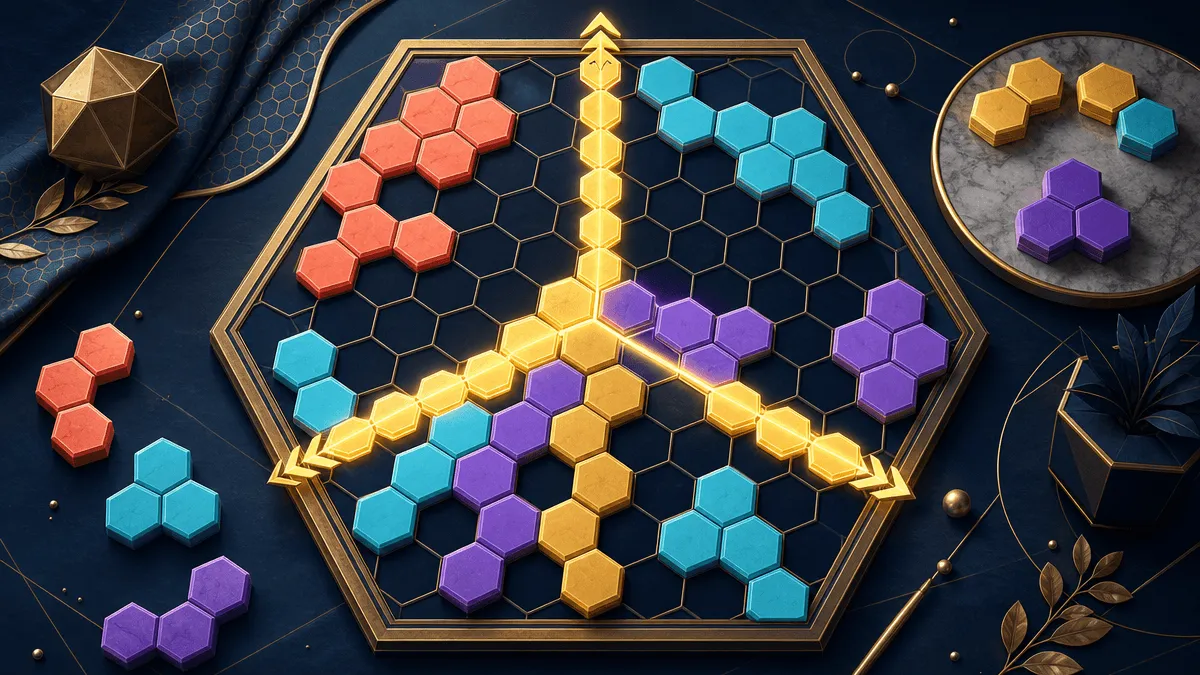
A strong Hex FRVR strategy protects usable space before chasing a single line clear. The board accepts hexagonal shapes and clears completed lines in three directions, so every placement changes several future routes at once. There is no timer, which makes deliberate piece order your most useful advantage.
Quick takeaways
- Check all three offered pieces before placing the first.
- Keep the center connected to several open directions.
- Avoid one-cell pockets and thin gaps.
- Use small pieces to repair structure, not automatically for instant points.
- Build two possible line clears when the board allows it.
On this page: rules · piece order · board space · recovery · FAQ
How Hex FRVR Line Clears Work
Drag an offered shape into empty cells on the honeycomb board. A full line clears when every cell is filled across one of the three board directions. The cleared cells become open again, which can create space for the next shapes and contribute to a higher score.
The run continues while at least one offered piece fits. It ends when none of the available shapes can be placed, so an attractive short-term score is not useful if it divides the remaining board into unusable fragments.
Choose the Best Piece Order
Review all three shapes before moving any of them. Start with the piece that has the fewest safe placements, especially when one is long, wide, or difficult to rotate mentally. Flexible small pieces can usually wait because they fit more locations.
Use this decision order:
- Find every valid location for the most awkward piece.
- Check whether another piece would block those locations.
- Place the restrictive piece first when the board is already crowded.
- Use the flexible piece to complete or prepare a line.
Protect Flexible Board Space
The center is valuable because pieces placed there can contribute to lines in several directions. Filling it completely too early can be as harmful as ignoring it. Build outward with connected shapes while leaving broad areas that accept more than one piece type.
Watch for three common space problems:
- A single empty cell surrounded by blocks.
- A narrow corridor that accepts only straight pieces.
- Two large open areas separated by a wall of blocks.
Each problem reduces the number of future shapes that fit. Repair it before adding blocks to a safer part of the board.
Build More Than One Line
Because lines cross on a hexagonal grid, one placement can support two or three future clears. Look for shared cells near an intersection and fill the surrounding lines gradually. A multi-line setup gives more value to the final piece and opens a larger connected region.
Do not force the setup when the required shape is unlikely to fit elsewhere. Keep at least one independent clear available so the board can recover if the next set is awkward.
Recover From a Crowded Board
When space becomes limited, stop optimizing for the largest immediate score. Place the most restrictive piece first, clear any reachable line, and connect separated empty areas. Small pieces become valuable recovery tools because they can close a nearly complete line without consuming an entire open zone.
Return to play Hex FRVR online and pause before every three-piece set. That one habit improves board awareness without requiring fast reactions.
Frequently Asked Questions
How do you clear blocks in Hex FRVR?
Fill every cell across one complete line. The hexagonal board supports line clears in three directions, and cleared cells become open space for later pieces.
Is there a time limit in Hex FRVR?
No. Hex FRVR is untimed, so you can inspect the offered pieces and board before each placement. Use the extra time to compare piece order and protect flexible space.
When does a Hex FRVR game end?
The run ends when none of the offered pieces can fit in the remaining empty cells. Avoid narrow gaps and isolated pockets so more shape types remain playable.
Conclusion
The most reliable Hex FRVR strategy is to plan all three pieces, protect connected space, and build clears in multiple directions. Treat small pieces as repair tools and awkward pieces as priorities when the board becomes crowded.
August 21,2026