The Forgotten Muscle Cars of America
Seven legendary machines history overlooked — obscured by marketing budgets, brand reputation, and the sheer volume of the muscle era's output. These cars deserved better, and their stories deserve to be told.
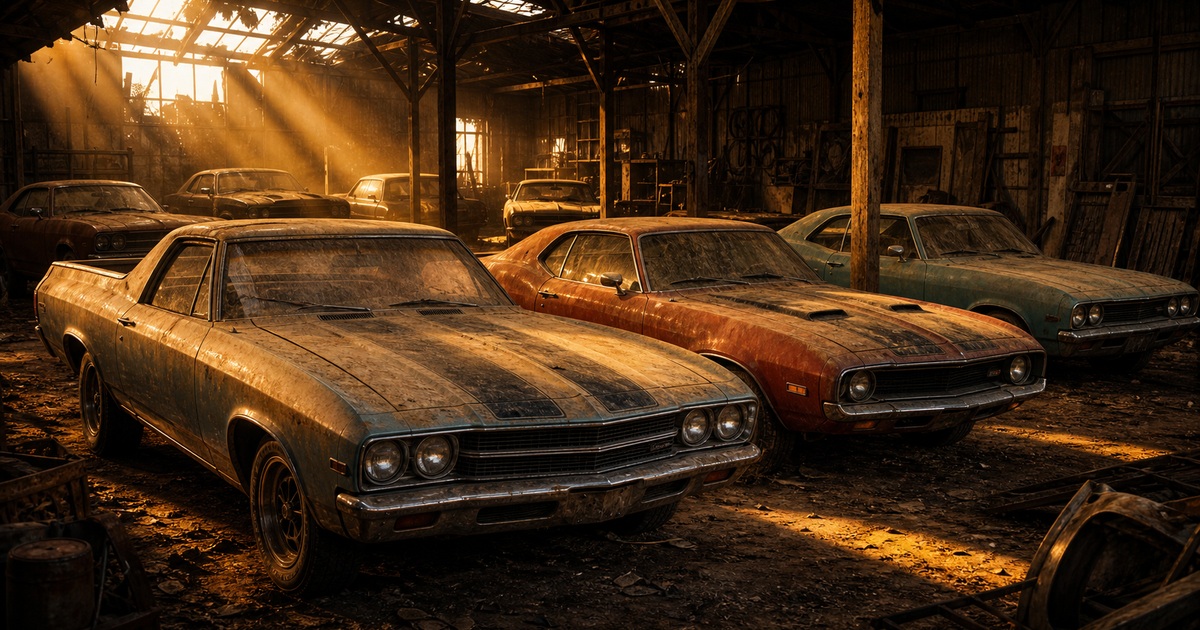
The muscle car era lasted barely a decade — 1964 to 1974 — but its output was staggering. Chevrolet, Ford, Dodge, Plymouth, Pontiac, AMC, Buick, Oldsmobile, and Mercury were all competing simultaneously, each launching new models and performance packages at a pace no manufacturer could sustain today. The result? Dozens of extraordinary machines that history simply didn't have room to celebrate.
These are the seven most criminally overlooked.
AMC Javelin AMX (1971)
Most OverlookedAmerican Motors Corporation was the underdog of the muscle era. The Javelin AMX packed a 401 cubic-inch V8 producing 330 hp — equal to many Chevys and Fords of the era. But AMC's small dealer network and marginal reputation meant most buyers never considered it. Today, a clean Javelin AMX is one of the most undervalued muscle cars at auction, often selling for half what a comparable Camaro commands.
Plymouth Barracuda 440 (1970)
Forgotten GiantThe Barracuda's bad luck was being born into the same family as the Dodge Challenger. Both were E-body Chrysler products launching in 1970, and the Dodge had the bigger marketing budget and dealer network. The Barracuda 440 — with the same 375 hp "Six-Pack" triple carburetor setup — outshadowed by its sibling. Today, numbers-matching '70 'Cudas command premium prices, but most casual enthusiasts still can't name them.
Buick GSX Stage 1 (1970)
Sleeper RoyaltyIn 1970, Buick built what many performance engineers considered the fastest production muscle car available. The GSX Stage 1 ran a 455 cubic-inch V8, officially rated at 360 hp (massively underrated from the factory to avoid insurance penalties). Road tests of the day recorded 0–60 in 5.5 seconds — faster than the legendary LS6 Chevelle by most measures. Yet Buick's "gentleman's brand" positioning meant few buyers even knew it existed.
Mercury Cyclone Spoiler (1969)
Aerodynamic PioneerNASCAR mandated that homologation specials — cars built to qualify a body style for superspeedway racing — had to be sold to the public. Ford's solution was the Talladega; Mercury's was the Cyclone Spoiler. With an extended nose cone designed in a wind tunnel and a 428 Cobra Jet under the hood, it was one of the most aerodynamically sophisticated production cars of 1969. Only 519 were built. Most people have never heard of it.
Oldsmobile 442 W-30 (1970)
Technical MarvelThe "442" designation stood for 4-barrel carb, 4-speed transmission, dual exhausts. The W-30 package added forced-air induction, special camshaft, and heavy-duty internals — effectively making it a factory-tuned racer. Oldsmobile positioned it as sophisticated rather than crude, which hurt its street cred. Meanwhile, its Pontiac GTO rival got all the magazine covers. The W-30 remains among the most technically interesting muscle cars ever built.
Dodge Super Bee (1969)
Budget RacerWhen Dodge wanted to compete in the lower price point of the muscle wars, they stripped the Coronet down to the essentials and dropped in a 383 Magnum V8. The Super Bee was NASCAR legend Charlie Glotzbach's favorite street car. It was raw, purposeful, and fast — but the "budget" reputation stuck. Collectors today pay premium prices for the 440 Six-Pack option, one of the rarest factory combinations ever produced.
Pontiac GTO "The Judge" (1969)
Almost FamousThe Judge is perhaps the least forgotten car on this list — but its cultural significance is wildly underappreciated. Pontiac named it after a Rowan & Martin's Laugh-In catchphrase ("Here come da Judge!") and painted it Carousel Red with a wing. It was a marketing masterstroke that blurred the line between performance car and pop culture artifact. Only the muscle era's collapse prevented The Judge from becoming an American icon on par with the Mustang.
Why These Cars Were Forgotten
The answer is simpler than you'd think: marketing. Chevrolet spent more promoting the Camaro in one quarter than AMC spent on the entire Javelin line in a year. Ford's Mustang had Steve McQueen in Bullitt. Dodge's Challenger had TV commercials. The Buick GSX Stage 1 — possibly the fastest production car of 1970 — got a small print ad in Road & Track.
The second factor is survival rate. Low production numbers meant fewer cars on the road, fewer in shows, fewer in the cultural conversation. An AMC Javelin in a parking lot in 1975 got puzzled looks; a Camaro got admiration. The market confirmed what the marketing had started.
But history is slowly correcting itself. As mainstream muscle cars reach prices that exclude ordinary collectors, these forgotten alternatives are finally getting their moment. The Buick GSX Stage 1 has tripled in value in the last decade. The Mercury Cyclone Spoiler recently sold at Barrett-Jackson for $220,000. The forgotten are being remembered.
🎮 Muscle Car Games
Muscle Car FAQ
What is considered a "muscle car"?
A muscle car is traditionally defined as a mid-size American rear-wheel-drive car with a powerful V8 engine, produced from roughly 1964 to 1974. The key distinction from sports cars: muscle cars prioritized straight-line acceleration over handling, and were priced for everyday buyers — not wealthy enthusiasts.
Why did the muscle car era end?
Three factors converged in the early 1970s: the 1973 oil crisis made big-engine cars economically impractical; federal emissions regulations required engines to be detuned; and insurance companies began charging young male drivers enormous premiums for high-horsepower cars. Production numbers collapsed from 1972 onward.
Which forgotten muscle car is most valuable today?
The Mercury Cyclone Spoiler and Buick GSX Stage 1 regularly command the highest prices relative to their original MSRP due to their rarity. A numbers-matching Buick GSX Stage 1 in excellent condition can fetch $150,000–$200,000 at major auctions.
Where can I play muscle car games for free?
EaseGame has Car Modified Master 3D for customization gameplay and Muscle Car Builder (AI-generated) for a full build-your-own experience. Both are free browser games — no download required.