From Moonshine Runners to NASCAR
The Appalachian mountains of North Carolina. Dirt roads in the dark. Souped-up Ford flatheads outrunning federal agents. And somehow — a sport with 75 million fans.
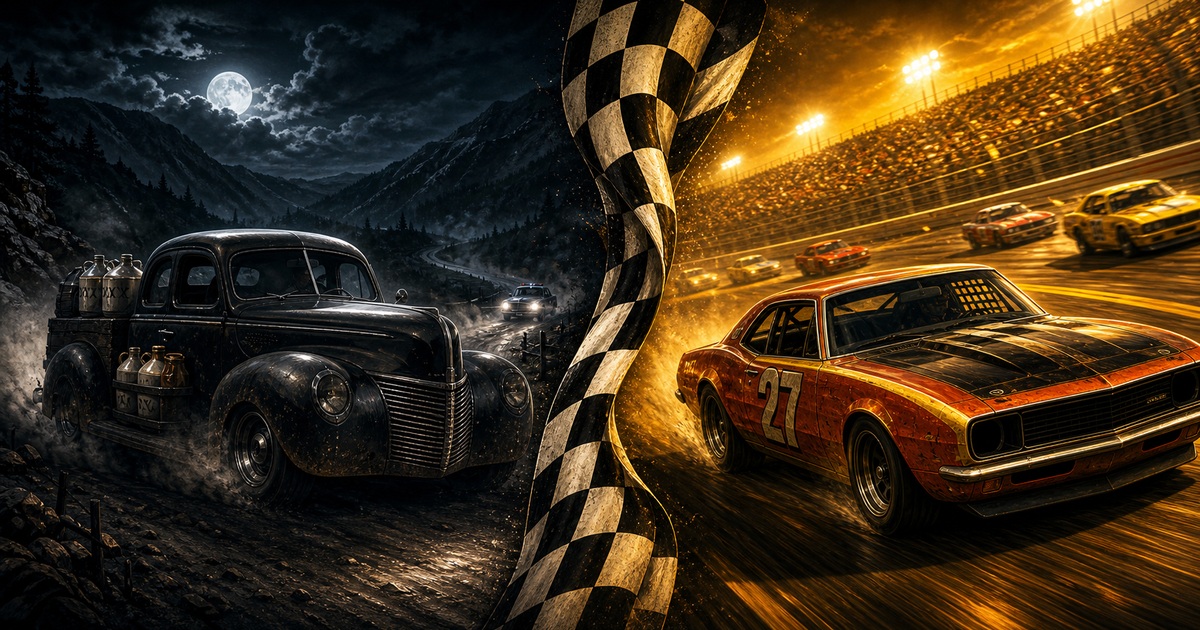
Before Daytona. Before Richard Petty. Before the $75 million sponsorship deals and the 80,000-seat grandstands, there was a simpler arrangement: a man, a Ford, a jar of corn liquor, and a federal revenue agent trying to take both from him.
The story of how NASCAR emerged from Prohibition-era moonshine running is one of American history's great accidental narratives — a story about poverty, ingenuity, and the peculiarly American belief that if you can make something go faster, everything else will work itself out.
The Appalachian Corn Whiskey Economy
Appalachian communities had been distilling corn whiskey since the first Scots-Irish settlers arrived in the 18th century. It wasn't illegal until Prohibition (1920–1933), and even after Prohibition ended, federal excise taxes on whiskey made legal production uneconomical for small distillers. The "revenuers" — agents of the Bureau of Alcohol, Tobacco and Firearms — were the constant threat.
Delivery drivers — called "trippers" — needed cars that could outrun government vehicles on mountain roads. This meant specific modifications: reinforced rear suspensions to handle heavy loads of mason jars, hopped-up engines for raw speed, and near-perfect weight distribution for the hairpin mountain curves. The drivers who survived and prospered were, by definition, the best car handlers in America.
The Flattened Ford: America's First Racing Car
The vehicle of choice was almost always Ford's flathead V8, introduced in 1932. Henry Ford's insistence on an affordable, powerful, mass-produced V8 created an unintended but perfect platform for bootleggers. The engine responded well to simple modifications — larger carburetor jets, better ignition timing, removal of the air cleaner — that could be performed by any competent mechanic in a barn.
Junior Johnson, who grew up in Wilkes County, North Carolina running moonshine for his father's operation from age 14, later described the mechanical education: "You learned more about cars running liquor than you could in any school. If something broke, you fixed it. If you wanted to go faster, you figured out why it was slow and changed it. You had to be your own engineer."
Bill France Sr. and the Organization of Chaos
Beach racing at Daytona had been happening informally since the 1930s. Locals and tourists would race on the hard-packed sand along the Atlantic, with no organized sanctioning body, inconsistent rules, and frequent disputes over results and payouts. Multiple promoters tried to regularize it; multiple promoters failed.
William Henry Getty France — "Big Bill" — arrived in Daytona in 1934 after driving south from Washington, D.C. with his wife and son when his car broke down. He liked it enough to stay. France was a mechanic and a promoter, and he saw in the beach racing chaos an opportunity.
On February 21, 1948, in the Streamline Hotel in Daytona Beach, France convened a meeting of drivers, car owners, and promoters and proposed a new national organization with standardized rules and guaranteed purses. NASCAR — the National Association for Stock Car Auto Racing — was born. France became its first president and remained so until 1972.
The Bootleggers Enter the Grandstands
The transition from moonshine running to legitimate racing was, for many drivers, simply a change of venue. The mechanical skills were identical. The temperament — high risk tolerance, mechanical ingenuity, competitive intensity — was exactly the same. The only difference was a paying crowd and a trophy instead of a federal fugitive warrant.
Tim Flock won 40 Cup races and two championships (1952, 1955) while also having worked in his family's Atlanta bootlegging operation. His brother Fonty Flock ran moonshine alongside him and won 19 Cup races. Their sister Ethel Flock raced as well, in an era before gender divisions were even part of the conversation.
Junior Johnson is the most mythologized. After his 1956 arrest and 11-month prison sentence, he returned to racing and won 50 Cup races as a driver — including the 1960 Daytona 500. As a team owner from 1965 onward, his teams won six NASCAR championships. Ronald Reagan granted him a presidential pardon in 1986, calling him "the last American hero."
North Wilkesboro: The Heartland of the Story
Junior Johnson's hometown county, Wilkes County, was also home to North Wilkesboro Speedway — the 0.625-mile oval that hosted NASCAR from 1949 until its closure in 1996. Johnson himself eventually owned the track.
The track's 2026 return to the Cup Series schedule (Window World 450, July 19) closes a circle that few expected to see completed. The spiritual home of stock car racing — the county where bootleggers became racers — is back on the calendar. In 2026, when the field takes the green flag at North Wilkesboro, they'll be racing on the same red clay soil where Junior Johnson once outran the law on the way to making history.
🏁 Key Figures
Moonshine to NASCAR — FAQ
Did moonshine runners really invent NASCAR?
The connection is real but nuanced. Many of NASCAR's early drivers — including Junior Johnson, Tim Flock, and Fonty Flock — ran moonshine before turning to racing. The mechanical skills they developed evading revenuers (modifying engines, hiding weight, learning high-speed driving on mountain roads) translated directly into racing success.
Who was Junior Johnson?
Wilkes County, North Carolina native Junior Johnson ran moonshine for his family from age 14. Arrested in a federal raid in 1956 and serving 11 months in prison, he returned to racing and won 50 Cup races as a driver before becoming one of the sport's most successful team owners. President Ronald Reagan pardoned him in 1986.
Where did early NASCAR racing happen?
The first sanctioned NASCAR race took place on the beach-road course at Daytona Beach, Florida on February 15, 1948. The course ran along the Atlantic Ocean's hard sand for 1.5 miles, turned on the road, and came back south — a combination of beach and asphalt impossible to replicate today.
How did Bill France Sr. start NASCAR?
Bill France Sr. was a mechanic from Washington D.C. who moved to Daytona Beach in 1934. He organized informal races on the beach, saw the commercial potential, and founded NASCAR (National Association for Stock Car Auto Racing) on February 21, 1948 in Daytona Beach's Streamline Hotel. He ran the sanctioning body as a virtual dictator for 24 years.