

From Wordle to Daily Quests: How 'One-a-Day' Became Gaming's Biggest Trend
You know the feeling. Wake up, grab coffee, phone in hand — and before checking email or scrolling through social media, you tap that one app first. The daily puzzle. The daily run. The daily whatever-it-is that you've been playing for months, maybe years.
It's not just you. This is how millions of people start their day now.
The "one-a-day" gaming format — one fresh challenge every 24 hours, same for everyone — has quietly become one of the biggest shifts in how casual games get played. What started with Wordle in 2021 has spread into everything from crossword apps to arcade runners. And the weird part? People keep showing up. Day after day. After day.
So what's actually going on here? Why does "only once per day" make something more playable, not less? And if you're looking to jump in, where do you even start?
The Wordle Spark — How Five Letters Changed Everything
Let's rewind to late 2021. Josh Wardle drops Wordle — a bare-bones word guessing game he built as a gift for his partner. No ads. No notifications. Just six tries to guess a five-letter word, one puzzle per day, shared through a grid of colored emoji squares.
It exploded.
By January 2022, Wordle had millions of daily players. The New York Times bought it for seven figures. And suddenly, every game developer was asking the same question: What if we did this, but with our thing?
The formula wasn't complicated. Five key elements:
- One puzzle per day. Everyone gets the same challenge.
- No endless scrolling. You finish in minutes, not hours.
- Shareable results. Those emoji grids became social currency.
- No FOMO. Miss a day? No big deal. It'll still be there tomorrow.
- Zero friction. No account required, no ads in your face.
Wordle proved that restraint — actively limiting how much someone can play — can be a feature, not a bug. People didn't bounce because they couldn't binge. They came back because the scarcity made it matter.
Why the "One-a-Day" Format Actually Works
It sounds counterintuitive. Video games have spent decades optimizing for engagement, retention, session length — the whole "keep them playing forever" playbook. Daily challenges flip that script entirely.
Here's what's happening under the hood.
Scarcity creates anticipation. You can't grind through 50 levels in a weekend. The puzzle drops at midnight, and if you miss it, it's gone. That constraint turns a casual habit into something people actually think about ahead of time. It's appointment gaming, but on your own terms.
Social sharing without spoilers. This is the Wordle breakthrough. When you share your result, you're showing how you did without giving away the answer. Someone who hasn't played yet can look at your green-yellow grid and still have their own experience intact. That balance — shareable but not spoiler-y — made it okay to talk about games in group chats that never discussed games before.
Low commitment, high satisfaction. A daily challenge takes 3 to 10 minutes. You finish, you get a result, you move on. No half-hour sessions, no guilt about quitting mid-level. It fits into the cracks of your day — waiting for coffee, commuting between meetings, killing time before bed.
Ritual and routine. Habits form around cues. Wake up → Wordle. Lunch break → chess puzzle. After dinner → crossword. The daily cadence locks into existing routines in a way that "play whenever" games never do. It's not just a game anymore. It's part of the day.
Beyond Wordle — Where Daily Challenges Show Up Now
The pattern didn't stay confined to word games. Once developers realized the formula worked, daily challenges started popping up everywhere.
Puzzle games. Daily crosswords, sudoku, nonograms, picross — the traditional newspaper puzzle model translated perfectly to apps. The New York Times built an entire games subscription around daily puzzles. The Guardian did the same. Hundreds of indie apps followed.
Trivia and knowledge games. Geography challenges ( Sporcle's daily country guessing), history quizzes, science trivia — anything where facts get tested works well in a daily format. There's something satisfying about learning one new thing every day, even if it's just that Luxembourg exists.
Arcade and action games. Daily runs in rogue-like games. Leaderboard challenges in rhythm games. The specific game changes, but the core loop is the same — today's course, today's score, try again tomorrow.
Card and board games. Daily Solitaire deals. Daily chess puzzles from Chess.com. Daily scrabble-style word games. The physical game formats that already existed as "one per day" in newspapers or magazines found a natural home in apps.
The common thread? They all work best when you're not trying to squeeze hours out of them. The constraint is the point.
What Makes a Daily Challenge Actually Good
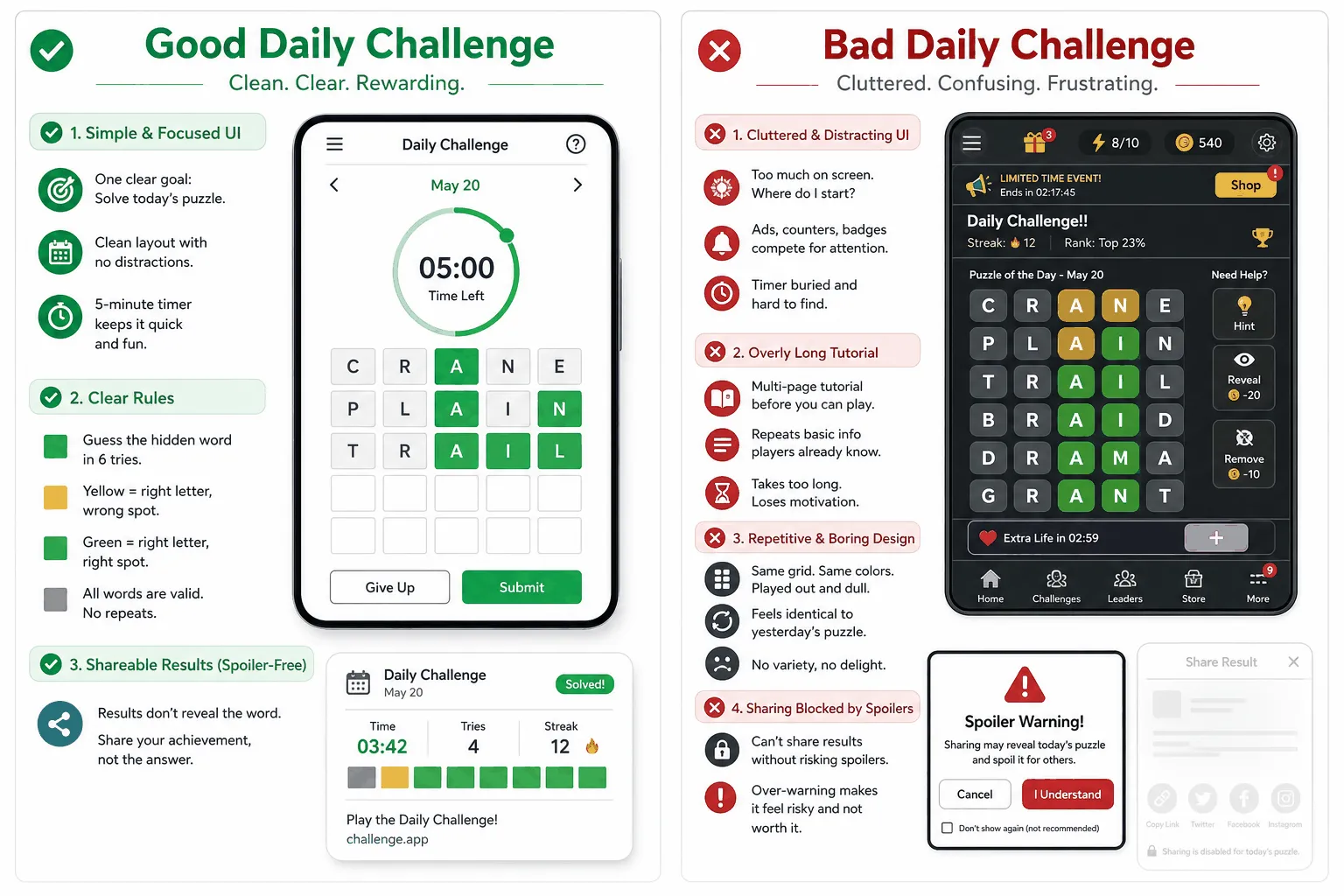
Not all daily games are created equal. The good ones share a few traits that the bad ones miss.
The puzzle feels fresh, not recycled. A daily sudoku generator should actually produce new puzzles, not cycle through a library of 50 presets. You can tell the difference after a week. The good ones don't feel repetitive.
The difficulty curves right. Too easy and it's boring. Too hard and people bounce off. The best daily challenges sit in that Goldilocks zone — challenging enough that you feel smart when you solve it, easy enough that you rarely quit in frustration.
Sharing doesn't spoil. This is the Wordle lesson. If you can't share your result without ruining someone else's experience, the social momentum dies. Look for games that show your stats or score without revealing the solution.
It respects your time. If a "daily" game is actually asking for 20 minutes of focused attention, it's failing the format. The sweet spot is 3 to 10 minutes. Anything more feels like work.
The rules are clear upfront. You shouldn't need a tutorial to understand today's challenge. The best daily games have simple, intuitive mechanics that you can grasp in seconds.
How to Build Your Own Daily Gaming Routine
If you're looking to jump into the daily challenge scene, here's the thing — you don't need to hunt down five different apps. Some places actually pull multiple daily games into one spot.
Start somewhere that already has variety. Instead of downloading a crossword app, then a trivia app, then a puzzle app — find a platform that offers a rotation. Less clutter, less switching around, more time actually playing.
Pick 2–3 different types. A word game plus a logic puzzle plus something quick and action-y. That way you're not solving the same kind of problem every day. Your brain stays engaged because it's doing different things.
Lock it to a specific time. Morning coffee? Lunch break? Evening wind-down? Pick a slot and stick with it. The routine is what keeps you coming back.
Don't overcommit. The whole point is that these are low-pressure. If you miss a day, no big deal. The next one's coming tomorrow either way.
If you're looking for a place that brings together multiple daily challenges — puzzles, word games, arcade runs, all in one spot — daily.easegame.com has a rotating lineup that updates every 24 hours. No app downloads, no account required. Just show up, play today's set, move on with your day.
The Daily Revolution Isn't Fading
Three years after Wordle hit it big, daily challenges aren't going away. If anything, they've become a permanent fixture in how casual games get designed and played.
The shift makes sense when you think about it. People are busy. Attention is fragmented. The idea of committing to an hour-long gaming session feels like a lot. But five minutes? That's doable. That fits.
Daily challenges aren't replacing longer, deeper games. They're coexisting alongside them. You can still sink 200 hours into an RPG on weekends and still spend three minutes on a word puzzle every morning. They scratch different itches.
The format works because it respects your time while still giving you that "I solved something" satisfaction. And in a world of endless content streams and infinite scrolling, there's something genuinely nice about a game that knows when to stop.
Try one this week. See if it sticks. You might be surprised how quickly "just today's puzzle" becomes part of the routine.
June 4,2026