


Looks Simple, But It’s Surprisingly Brain-Teasing: The Hidden Complexity of Sand Loop
When most players first try Sand Loop, they tend to have the same initial impression: this is just a simple color-matching game. The rules are clear, the controls are straightforward, and it seems like it doesn’t require much thinking.
However, after a few levels, you quickly realize it’s not that simple. Many actions that feel “obvious” at first can actually lead you straight into a dead end.
What this game really tests is not your ability to recognize colors—but your understanding of order.
It Looks Like Color Matching, But It’s Really About Order
On the surface, the core mechanic is easy to grasp: each bucket can only collect sand of the same color. This creates a strong sense of direct matching, making players assume that they can act immediately whenever they see the right color.
The problem is, sand doesn’t exist independently—it has layers.
In most levels, upper layers sit on top of lower ones. Only after the bottom layer is cleared can the sand above it be collected. In other words, the game isn’t asking “what color should you pick,” but rather “what should you do first.”
This shift—from choosing to sequencing—is where the real challenge begins.
The Counterintuitive Trap: Why Placing the Yellow Bucket First Fails
This is one of the most common early-game mistakes.
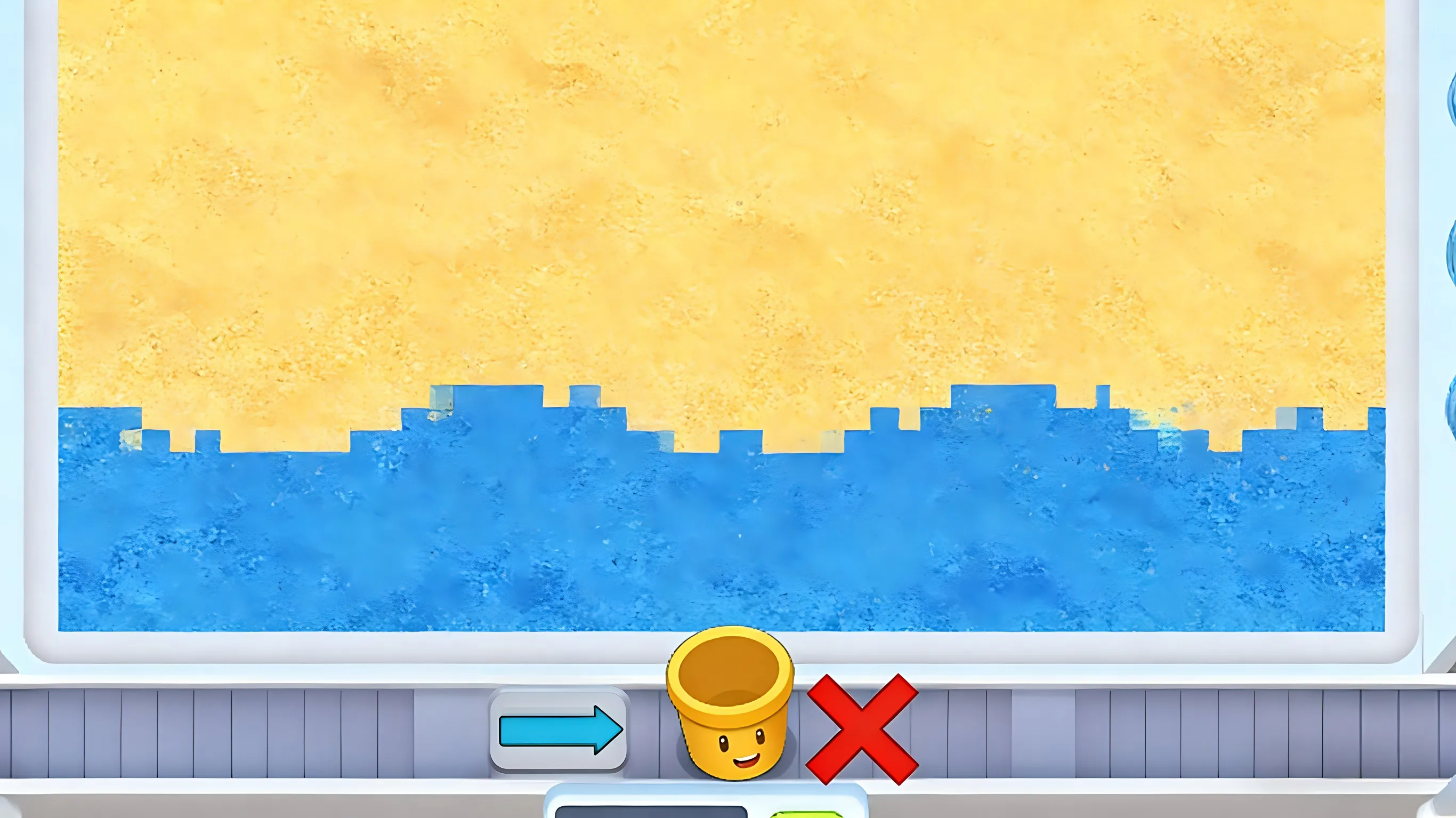
When you see a large area of yellow sand, your instinct is to place a yellow bucket first. But once you do, nothing happens—the bucket doesn’t collect anything.
The reason is simple: yellow isn’t at the bottom. There may be blue or other colors beneath it. According to the game’s rules, only the lowest visible layer can be collected first, so the yellow has to wait.
This creates a clear counterintuitive experience: what you see isn’t what you can act on. The correct approach is often to deal with less obvious bottom layers first, gradually unlocking the layers above.
The Most Common Player Mistakes
Because of this design, players often fall into a few predictable traps.
- React purely to what they see. Visual cues strongly influence decisions, but in this game, surface information can be misleading. Ignoring the underlying structure often leads to early mistakes.
- Focus only on the current move without considering its consequences. Some choices seem valid in the moment but end up blocking future actions, eventually creating a deadlock.
- Underestimate bucket space. The conveyor belt has a fixed number of slots, and once they are filled with incomplete buckets, you lose flexibility. This limitation amplifies the impact of every decision, making mistakes much harder to recover from.
The Core Mechanic: Managing Dependencies
At its core, Sand Loop is less about matching and more about managing dependencies.
Each layer of sand may depend on another being cleared first. The bottom layers act as prerequisites, while upper layers are the result. Only when conditions are met can new actions become available.
This means players need to mentally map out a hidden sequence: Which layer must be cleared first? Which bucket should be used now? Which move might block future progress?
Once you start thinking this way, the experience changes completely. It’s no longer a simple matching game—it becomes a light but satisfying form of strategic planning.

Why This Design Is So Addictive
This combination of simplicity and hidden complexity is exactly what makes Sand Loop so engaging. On one hand, the rules are easy to understand, allowing anyone to jump in without a learning curve. On the other hand, each decision carries weight, requiring just enough thought to stay interesting.
More importantly, the game creates a strong sense of delayed gratification. You may know that a certain color can be collected, but you’re forced to wait until the right conditions are met. That delay makes success feel more rewarding.
Even failure feels fair. When you get stuck, it’s usually clear that the issue wasn’t a lack of ability, but a mistake in order. That “I was so close” feeling encourages players to try again.
Conclusion: Simple Rules, Complex Decisions
What makes Sand Loop stand out is how it builds a deep decision-making system from very simple rules.
Players aren’t just matching colors—they are constantly balancing order, space, and resource management. That’s why, despite its casual appearance, the game continues to deliver meaningful mental engagement.
If you think it feels “too easy” at the beginning, that’s completely normal.
The moment you start wondering which bucket to place first—you’re already hooked.
April 8,2026